

Thoughts
Emotions
The Body (Sensation/Biology)
One-word descriptors (sad, itchy, tense)
"Anxious"

Emotions are complicated because sensory input always passes through the brain's emotional centers before reaching areas responsible for rational thought, so emotional reactions typically precede conscious activity. However, thoughts can either create or intensify emotions and their duration.
Rule of Thumb: If you can start a sentence with "I feel that..." or "I feel like...", you are actually describing a thought, not an emotion.
Example:
User says: "I feel ignored."
The Reality: "I think they aren't listening, and I feel lonely."
User says: "I feel like a failure."
The Reality: "I think I didn't meet my goal, and I feel ashamed."


Thoughts and emotions, though related, are distinctly different. Thoughts involve inner dialogue and analysis, while emotions are felt as physiological responses and subjective feelings. Thoughts arise from our conscious inner dialogue, shaped by ideas, judgments, and beliefs. For example, “I feel like I am not good enough” is a thought, not an emotion, even though it is described as a feeling. This thought can lead to feelings of sadness, an emotion often associated with the thought. Emotions can occur in response to thoughts or to other triggers, and associated thoughts often follow the emotion. In this way, specific thoughtsand emotions become linked or associated in memory.
Distinguishing Between Emotions and Thoughts
Perception

Thoughts
The Mind (Logic/Language)
Full sentences, opinions, judgments.
"I'm going to fail this presentation."
Emotions are feelings like happiness, excitement, sadness, anger, or fear. Each emotional state is a specific cocktail of biological changes in the body, regulated by chemicals like hormones, neuromodulators, and endorphins.
It is easy to confuse thoughts and emotions, as each can influence the other. Distinguishing between them is important because thoughts are easier to control consciously, whereas emotions are more automatic and have a biological footprint. "I feel like you're being mean," is actually a thought, not a feeling. It is a perception that may be incorrect. I feel sad about how you are treating me, which conveys a completely different message. It communicates an emotion and prompts discussion without judging or blaming the second person. These differences are subtle but important in effective communication.
Emotions
The Trigger: A car cuts you off in traffic.
The Thought: "That person is a jerk and they almost killed me!" (The Narrative)
The Emotion: Anger, fear, or adrenaline. (The Physical Spike)
The Action: You honk the horn.
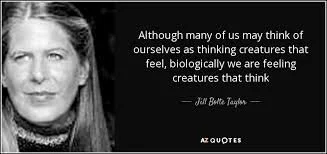
Neuroanatomist Dr. Jill Bolte Taylor notes that when a thought triggers an emotion (like anger or fear), the chemical flush lasts only 90 seconds. If the feeling lasts longer, it’s because you are "re-triggering" it with your thoughts. If you can use one of the thought or emotional management tools for just a minute and a half, the physical urge to spiral will naturally dissipate.
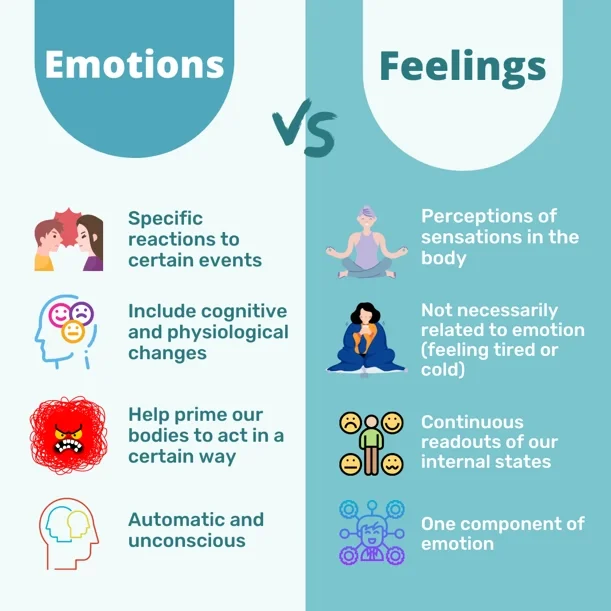

It can be frustrating when someone tells you to stop feeling a certain way; you can’t simply turn emotions on or off. You can become aware of the thoughts that generate and reinforce the emotion and work on changing your perspective, which will help you gain more control over your emotions.
Separating emotional reactions from the thoughts that drive, maintain, or support them can foster mindfulness and cognitive-behavioral practices that restore balance and promote growth.
Words vs. Feelings: Thoughts typically manifest as language, while emotions manifest as physical sensations.