

Happiness & Joy
The Art of Well-being
Introduction to Happiness and Positive Emotions
It’s probably safe to say we all want happiness—to feel good, enjoy life, and live up to our full potential. Unfortunately, not everyone achieves this goal.
Research shows that only about 20% of adults consider themselves happy or flourishing, while most feel they are languishing or struggling. Studies further indicate that cultivating positive emotions leads to greater creativity, improved problem-solving skills, and improved physical health. By actively seeking experiences that foster happiness, individuals can bolster their emotional reserves and better navigate life’s challenges.
Happiness is not a destination to reach, but a "situation selection" process. By selecting environments and habits that foster spontaneous joy, you raise your baseline well-being over time.
Resilience and Coping Skills
Life can be demanding, and even the strongest individuals may feel disconnected or trapped in negative thoughts during adversity. However, we can choose how to cope with our struggles, and within that choice lies the opportunity to discover happier versions of ourselves. While we cannot change many of life’s external events, we can learn to respond more skillfully to the challenges they present. In this section, we examine happiness and the specific behaviors that foster it.
In this section we will cover:
One Popular Definition of Happiness, P E R M A
What Happiness Does for You
Being Around Happy People
Happiness Set Points
Mind-Wandering and Happines
Building Healthy Habits-Strategies to Improve Happiness
Happiness Builds Success

Defining Happiness
A Popular Definition
Happiness is frequently defined as experiencing joy, gladness, satisfaction, contentment, and a sense of positive well-being. It encompasses more than a good mood; happiness is a state of well-being that emerges from repeated positive experiences and a sense of meaning and contentment.
Dr. Seligman’s popular definition of happiness includes five components captured in the acronym PERMA:
· P – Positive Emotions or Pleasure: Happy people are generally more positive and upbeat, but happiness is more than fleeting pleasure. It is a sustained emotional state derived from meaningful activities, such as spending time with others, helping someone, or performing acts of kindness.
· E – Engagement: Happy individuals seek activities that provide “flow”—deep, effortless involvement in moderately challenging tasks where time and self-consciousness fade away.
· R – Relationships: Positive relationships enrich our lives. Humans are inherently social; most of us thrive on positive interactions.
· M – Meaning: Happiness includes feeling that life serves something greater than oneself—a sense of purpose, mission, or goal you hope to achieve.
· A – Accomplishment: Pursuing accomplishments with positive emotion and meaning, rather than purely for their own sake.
This definition helps break down happiness into actionable behaviors and areas for growth. This definition also helps us understand that happiness is not just about being bright and sunny; it involves discipline, skill development, self-care, and character growth.Happiness has been defined in many ways. Google definitions will generally focus on experiencing joy, gladness, satisfaction, contentment, positive well-being, and a sense that one’s life is good, meaningful, and worthwhile. Happiness is more than just a positive mood; it is a state of well-being that seems to evolve from multiple positive experiences combined with a sense of meaning and deep contentment.

Digging Deeper Into PERMA?
P - Positive emotions: Maximizing positive emotions while minimizing negative emotions. Happy people are generally more upbeat emotionally, but this differs from what we traditionally think of as pleasure. Happiness pleasure is long-term rather than short-term self-indulgent pleasures like buying things or rewarding activities. Happiness and joy are derived from being with others, giving, or doing good deeds.
E - Engagement: Seeking out activities that provide flow—a state of deep, effortless involvement in which you concentrate on a moderately challenging task, and your sense of time and self vanishes.
R - Relationships: Positive relationships bring many good things to our lives. We are social beings, and though some of us may not enjoy social situations as much as others, we still require positive interaction to flourish.
M - Meaning: Feeling that your life serves something greater than yourself. You feel a sense of purpose, a reason to get up and act in service of a goal, purpose, or mission.
A - Accomplishments: Seeking accomplishment as long as it is pursued with positive emotion and meaning, not just for its own sake.
This definition came from the study of people who rate themselves as happy. A uniform definition of happiness is helpful because it gives us direction or specific areas to strengthen and helps us break down the goal of being happier into particular behaviors we can strive to increase. This also allows us to understand that happiness is not just being bright and sunny or having a positive mindset; happiness involves hard work, building skills, and character strengths. If you want to become happier, look at the behaviors associated with happiness and incorporate them into your life.
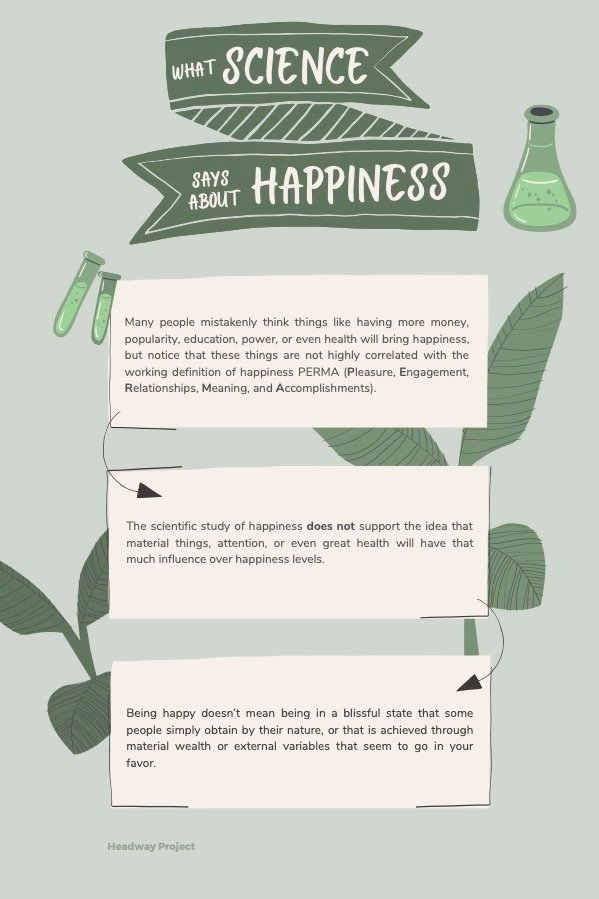
What Does Happiness Do For You?
Dr. Sonya Lyubomirsky, a leading researcher in happiness and positive psychology, has found that happy people consistently engage in behaviors like gratitude, optimism, savoring small pleasures, physical activity, living in the moment, social connections, generosity, and spirituality.
Positive emotions motivate, engage, energize, strengthen resilience, and boost productivity. An analysis of 225 scientific studies found that happier people are more productive, creative, resilient, financially successful, better leaders, healthier, and less prone to illness, divorce, and accidents. They also live longer and manage stress more effectively.
“Most people think that if they become successful, then they will be happy. But recent discoveries in psychology and neuroscience show that this formula is backward: happiness fuels success, not vice versa. When we are positive, our brains are more motivated, engaged, energetic, resilient, and productive.”
If you measure happiness in the workplace and come back 3 ½ years later and evaluate performance, the happier people will have been more productive and better at sales. They will be rated as getting along better with other employees.
Happy people are better at relationships, have more friends, spend less time alone, tend to be more committed to goals, and have a more genuine (Duchenne) smile.
If you induce even a transient mood of happiness, studies show that employees are temporarily more creative, flexible, and positive.
Being Around Happy People Makes You Happier!!
The Power of Social Connections
We naturally empathize with others' emotions, which means being around happy people can increase our own happiness. Conversely, being around people who are negative can lower our mood.
The idea that happiness can be learned is not intended to make people who are depressed or unhappy feel guilty because they are going through a rough time; people usually do as well as they can, but the argument is that taking steps to increase happiness helps everyone, regardless of where you are when you start.
So, happiness is good for you, but the big question is, how do we achieve and maintain these higher levels of happiness and experience these amazing benefits?
We can answer this question by examining internal and external factors that influence our happiness, resilience, and strategies for maintaining these positive emotions.


Intentional Behaviors (we can control)
Outside events can cause internal changes, but the point is that we have little control over outside events. As we navigate life, we can step back and hold external happenings in awareness while noticing internal thoughts and emotions and making better and more effective adjustments. This is where our ability to strengthen happiness originates. Behaviors like being more involved socially with people, having a wide range of acquaintances, developing a sense of community, a deep connection with your spouse or family, optimism and zest, expecting good to multiply, a sense of mission and meaning, doing more of what you are good at, or practicing gratitude are examples of things we can control which will gradually strengthen our happiness set point.

Understanding Happiness Set Points
Dr. Lyubomirsky and colleagues suggest we all have a “genetic happiness set point,” which accounts for about 50% of our happiness. External circumstances, like money or family, contribute roughly 20%, while intentional behaviors—our actions, attitudes, and choices—make up the remaining 30%.
While external events can influence emotions, long-term happiness is more closely tied to internal factors and deliberate behaviors. By focusing on the factors we can control, like social involvement, community, optimism, meaning, and gratitude, we can gradually shift our happiness set point in a positive direction.
Outside Circumstances
Resilience, or the ability to adapt to changing circumstances, means that while changes in the external world might increase positive emotions or pain and suffering, they will not necessarily or very effectively modify the long-term internal workings of happiness. Changes in this unique, highly individualized happiness set point are less influenced by external factors than we might think.
Strategies for Shifting Your Set Point
Changing your happiness set point is challenging. Genetics and external circumstances are largely out of our control, and intentional behaviors can influence happiness by about 30–35%. To make meaningful changes, you need a plan or system that leverages your positive intentions and builds on current knowledge about neuroplasticity and positive psychology. The TEACH Model provides a structure for knowledge and support to move toward greater happiness.
The Constant of Change
Our bodies continually experience fluctuations in endorphins, neuromodulators, neurotransmitters, hormones, and pheromones, all of which influence how we feel. Emotional ups and downs are normal, and learning to ride these waves is essential. While some reactions—such as being careful or relaxing—may be adaptive, excessive caution or relaxation can prevent us from finding happiness. Healthy coping skills and an understanding of the transient nature of emotions empower us to see happiness as a choice, cultivated through daily habits rather than as a distant destination we somehow arrive at when the stars all fall into alignment.
1. The Power of "Micro-Moments."
Science shows that high-intensity "peak" happiness is less sustainable than frequent, low-intensity positive emotions.
Savoring: Practice "attention deployment." When something good happens—a great cup of coffee, a sunset—pause for 30 seconds to fully acknowledge the sensation. This "savoring" reinforces neural pathways for joy.
The 10-Minute Green Break: Research confirms that as little as 10 minutes in a "green space" (parks, gardens, or even near trees) significantly lowers cortisol and lifts mood.
Micro-Connections: Don't underestimate "weak ties." Brief, friendly interactions with strangers (e.g., a barista or a neighbor) have been shown to reduce loneliness as much as some long-form conversations.
Healthy Daily Habits
2. Strategic Mindset Shifts
Happiness is often a byproduct of how we process our reality rather than the reality itself.
Progress Over Perfection: Adopting the "art of progress" reduces the anxiety of impossible standards. Celebrate "small wins" daily to maintain dopamine levels.
The Internal Locus of Control: Focus energy strictly on what you can control. Writing down stressors and categorizing them into "Control" vs. "Out of Control" helps "free up" mental bandwidth for joy.
Confelicity: This is the practice of finding joy specifically in the happiness of others. It creates a "bounce-back" effect where altruism triggers your own reward system.
3. The "Digital Detox" for Resilience
In 2026, the link between "over-consumption" of digital content and mental fatigue is undeniable.
Reduce the Input: Limit news and social media to specific "windows" rather than constant scrolling.
Analog Play: Re-engage with "frivolous" activities—Legos, board games, or drawing. Play is a vital regulator for the adult nervous system, fostering optimism and resilience.
Practice Basic Health Habits: Take care of your body; 30-40 minutes of exercise 3-5 times per week. Build deeper connections. Practice gratitude. Get 7 hours of sleep. Be mindful of nutrition. These small daily habits support Happiness.
Toxic positivity refers to the excessive and insincere promotion of a positive mindset, often at the expense of acknowledging and processing negative emotions. While positivity can be beneficial, toxic positivity can become detrimental in several ways.
1. Invalidation of Feelings: Toxic positivity can invalidate genuine emotions. When people are told to "just stay positive" or "look on the bright side," it can make them feel like they are paying too much attention to their struggles, which can lead to feeling more lonely and isolated.
2. Suppression of Emotions: Encouraging a constant state of positivity may lead individuals to suppress negative emotions instead of facing and processing them. This can result in unresolved feelings, increased stress, and potential mental health issues over time
3. Inauthentic Relationships: Toxic positivity can create superficial interactions where people cannot share their true feelings. This lack of authenticity can strain relationships, and individuals may feel they must hide their struggles.
4. Avoidance of Necessary Conversations: By focusing only on positive outcomes, important discussions about problems, challenges, or mental health may be avoided. This can hinder personal growth and the opportunity to address issues that need attention
5. Pressure to Perform: Individuals may feel pressured to maintain a happy facade, leading to burnout and anxiety. The expectation to always be positive can create a sense of inadequacy, especially when someone is struggling.
While a positive outlook can be beneficial, toxic positivity can hinder emotional well-being, create barriers in relationships, and discourage healthy emotional processing. It's important to strike a balance that allows for the acknowledgment of both positive and negative experiences.
Healthy Positivity Vs. Toxic Positivity

A Note About Sharing Meals Together
Sharing Meals and Happiness
The World Happiness Report identifies social connection as the best predictor of happiness, surpassing factors like income, life expectancy, freedom, generosity, and corruption perception. Trustworthy friendships powerfully influence happiness. The US ranks 24th in the world in happiness, with a score of 6.7 out of 10 in 2025.
Globally, sharing meals is strongly linked to well-being, comparable to income and employment. More frequent shared meals are associated with higher life satisfaction and positive mood. Even one more shared meal per week can significantly boost happiness—equivalent to moving five places up in global happiness rankings.
Despite this, Americans are dining alone more often, with 1 in 4 eating all meals alone in 2023. Loneliness and isolation carry health risks equivalent to smoking 15 cigarettes daily. In the words of Dr. Chris Peterson, “other people matter.”

Mind-Wandering and Happiness:
The Art of Being Present
Mind-Wandering, Brain Networks, and the Power of Being Present
Have you ever caught yourself daydreaming while doing the dishes or thinking about your to-do list during a conversation? You’re not alone. In 2010, Harvard psychologists Matthew Killingsworth and Daniel Gilbert developed an innovative “track your happiness” iPhone app that pinged people randomly during the day and asked them three simple questions: What are you doing? What are you thinking about? And how happy do you feel right now, on a scale from one to ten?
Their research revealed something surprising: nearly half the time—47%, to be exact—people reported that their minds were wandering, not focused on the task at hand. Even more interestingly, people felt significantly happier when their thoughts aligned with their activity, compared to when their minds wandered elsewhere. Similar findings have been confirmed in other studies, underscoring the significant impact our attention has on our happiness.
What’s happening in the brain during these moments? When we get caught up thinking about the past or worrying about the future—a mental habit called “mind-wandering” or “mental time travel”—our Default Mode Network (DMN) switches on. This brain network is active when we’re not engaged with the present moment and instead replay old memories or anticipate what’s next. Unfortunately, spending too much time in DMN mode often leads to negative self-talk and rumination, as our minds tend to revisit regrets about the past or anxieties about the future.
In contrast, when we focus our attention on what we’re currently doing, we activate a different brain network called the Task Positive Network (TPN). The TPN is engaged whenever we’re involved in an attention-demanding task—anything from folding laundry to reading a book or even doodling. Research shows that activating the TPN is directly linked to greater happiness, because it helps us stay grounded in the present and quiets that inner critic.
Focusing on the present shifts us out of the DMN and into the TPN, which means less negative self-talk and more positive feelings. According to Killingsworth and Gilbert’s study, simply paying attention to what you’re doing can boost your mood by around twenty percent. You don’t need a complicated routine to practice this. Washing your pet, playing a video game, noticing details in your surroundings, or even organizing your desk can all become opportunities to anchor yourself in the now. The key is to bring your full attention to whatever you’re doing, instead of letting your mind wander. This is present-moment awareness.
Here’s a real-life example: Lisa often found herself feeling down after work, replaying stressful moments from her day during her evening walk. One day, she decided to try something different—she focused on the sensations of her feet hitting the ground, the sound of birds, and the colors of the sunset. By intentionally tuning into the present, Lisa noticed her mood lifting. Walking became not just a way to get home, but a simple practice for greater happiness.
So next time you catch your mind wandering, try bringing it gently back to the present moment. Your brain—and your mood—will thank you.
Default Mode Network
Building Healthy Habits for Happiness
Learning about happiness is a great starting point, but lasting emotional well-being goes beyond acquiring knowledge—it requires intentional, ongoing behavioral changes on multiple levels. While popular frameworks like B.J. Fogg’s Tiny Habits and James Clear’s Atomic Habits emphasize motivation, ability, and consistent practice for forming specific habits, the TEACH Program offers a more systemic approach. Building on specific, individual habit frameworks, the TEACH Program offers a comprehensive approach to integrating thoughts, emotions, attention, connections, and health into a cohesive system designed to strengthen emotional well-being.
Developing Healthy Habits


Even with motivation, consistently practicing new behaviors until they become habits can be challenging. Growing happiness means accepting and letting go of unhelpful behaviors and building new, helpful habits. This is complicated because unhelpful behaviors that have been repeated often have developed “habit strength”. Changing unhelpful behaviors and developing new, helpful ones requires a system. Lasting change requires a plan that supports small, incremental improvements. The TEACH Program enables self-improvement by systematically addressing Thoughts, Emotions, Attention, Connections, and Health. Small daily changes are achieved by practicing Tiny, Easy, Attractive, Consistent Habits (“little TEACH”). The Headway Project offers practical strategies proven to be associated with greater happiness, along with a framework to help you develop your own system. For instance, a tiny habit could be taking three deep breaths each morning before getting out of bed to center your attention and set a positive tone for the day. Another example might be sending a quick text of appreciation to a friend to strengthen social connections, or jotting down one thing you’re grateful for each evening to nurture positive emotions.
Atomic Habits by James Clear and Tiny Habits by B.J. Fogg are excellent resources that provide practical strategies for building good habits. New behaviors need cues or prompts, should be broken down into manageable steps, and frequently celebrated—no matter how small the achievement. The basic steps: select a desired outcome, design prompts to support behaviors, and follow through with the three Rs: Respond, Reward, and Repeat.
These principles aren’t just for building positive emotions; they apply to every element of the TEACH Model. Because everyone’s needs are different, the program offers a range of options to help you discover what works best for you. For more in-depth science and strategies, our website’s Emotions section includes research-based techniques for improving happiness.
Designing a System of Prompts or Cues
It is helpful to identify a suitable time and place in your daily routine to practice new behaviors. Associate them with established routines and fit them into your schedule, or, for areas like thoughts and emotions, build in cues to support strategies you want to remember. Sometimes, the hardest part is remembering to practice the strategy. Writing it down, as in journaling, and building cues into your environment can be helpful. Make changes easy and more rewarding, especially at first. Your system may also need to include strategies to make unhelpful behaviors less appealing by adjusting your rewards and reviewing your current values to ensure they align with your behaviors, and developing a plan to make any necessary changes. esigning A System of Prompts or Cues
Selecting Behaviors to Support Happiness
To develop habits that support happiness, focus daily on the small details that make life enjoyable. Utilize the TEACH ecosystem and strategies, including Noticing, Balancing, Focusing, Managing, and Practicing. Select strategies that resonate with you, write them down, and create prompts to guide your desired behaviors. Start with actions so small they are almost effortless—one push-up, one minute of meditation, or swapping a snack for a healthier alternative.
Examples of small behaviors to build upon include:
· Noticing and appreciating small joys throughout your day
· Focusing attention on loved ones or pets
· Balancing work and play
· Being more social, smiling, or sharing a joke
· Helping others and focusing attention outward
· Maintaining a neat and organized environment
· Lowering stress levels
· Time management and planning (e.g., Time Block Planning, Vision Boards)
· Practicing acceptance and letting go of irritations
· Using breathing, mindful walking, and self-calming strategies
· Maintaining healthy habits in nutrition, hygiene, hydration, sleep, and exercise
· Practicing self-compassion, especially after mistakes
· Bringing yourself back to the present when your mind wanders
· Slowing down and savoring good moments
We hope these ideas will help you cultivate happiness and greater enjoyment in life.

Example of a Vision Board

Example of a completed Vision Board
Example: Establishing a Sustainable Exercise Routine
Mr. R decided to work on his health by selecting exercise as a behavior he wanted to strengthen. He started with a simple plan: do a few push-ups just before he left his office at the end of the day. This was an easy, manageable amount of effort: ten push-ups. For the first few weeks, he did this every day just before leaving his office. The initial focus was on consistency, establishing a routine, and helping his brain and body learn, remember, and adapt.
After a few weeks, 10 push-ups became too easy, so he increased to 15. This change was still relatively easy and not too much of a strain. He didn’t think much about it; he simply made push-ups part of his daily routine. Leaving the office became his immediate daily reward for his exercise, strengthening the habit.
After a few more weeks, he began to walk a few blocks after arriving home. His spouse joined him for the walk. They used this time to discuss their day and plan activities. The walks soon became an enjoyable daily activity.
After four or five additional weeks, he was up to 25 push-ups. Within a few months, he was able to do 35 push-ups and walk about a mile. As time passed, he started feeling better, so he added ten squats and a few sit-ups after finishing the walk. This became a daily routine.
He focused on consistency and occasionally shared his plan with others, which further strengthened his commitment. After a year, his routine included 50 push-ups, a two-mile walk, 25 sit-ups, and squats. He performed this routine around four times a week, always at the same time, beginning with push-ups just before leaving the office each day. Going home became the reward for completing the push-ups and prompted additional behaviors once he arrived home.
Three years into this plan, Mr. R was at 65 push-ups, 50 sit-ups, 50 squats, and a 3-mile walk every day. His wife joined him on the walk, and they shared stories about their lives together.
The prompt of finishing his workday helped keep him on track. Immediate rewards, such as self-praise and going home, were motivating. The long-term rewards included improved health, stamina, and appearance.
He added small behaviors over time, so that one behavior led to another, creating a chain of actions that ended with a shower and dinner routine.
An interesting aspect of this plan is the body's ability to adapt. After weeks of following a routine, Mr. R found his body began responding automatically, as if it had developed a “memory.” This made it easier for him to add new behaviors without much physical strain as his stamina increased.
The secret to his plan was consistency and compounding of small behaviors over time. He had to prioritize these behaviors and establish boundaries around this time interval to protect his routine. Small, positive behaviors added up over time and became habits.
One downside was that his exercise plan was highly context-dependent; it occurred only on days when he was in his office and only at the end of the day. If he left the office at noon, his routine was disrupted. When he did not go to work (on vacation or taking time off), he was less likely to engage in the behavior, making it easier to break the habit. The prompt, however, was there when he returned to work, helping him get back on track.
It was hard when he missed a few days. Sometimes, he reduced his daily effort until he could get back into a routine. This helped him notice how quickly his muscles deteriorated when he stopped exercising, reinforcing his commitment to maintaining his exercise routine. He learned from Tiny Habits not to get discouraged when he missed a day or two. There were times when he was tired or not feeling well, so he did not get down on himself when he missed a day or so; he just got back on schedule and was typically able to average exercising three to four days a week. This plan has been in effect for approximately eight years. One caveat about behavior change is to focus on changes that are relatively permanent, for example, behaviors you intend to continue for the rest of your life. This is a different mindset than trying to accomplish a short-term goal.
Since his plan was highly contextualized, over time, he began varying the location by making slight changes, exercising in different places within his office or home, and adjusting the time of day. These adjustments helped reduce contextual dependency and supported exercise behaviors in various locations and at different times.
Mr. R used the book Tiny Habits to help with the nuances and motivation for his plan, but his plan might not work for someone with daily at-home responsibilities, such as caring for children, or for people who work from home or live in climates where walking outside isn’t easy, safe, or comfortable. Plans must be tailored to a person’s situation and their routine. His plan is an example of how prompts are essential, as life often disrupts routines and can lead to failure if you don’t plan for and expect the unexpected. A sound system helps you get back on track during unexpected disruptions. Once behaviors are well-established, prompts are no longer as critical.
Just as these strategies worked for physical health, similar principles can be applied to emotional well-being. Compared with exercise, cultivating happiness and positive emotions is more complex and involves a broader range of behaviors. Emotions emerge from numerous small, overt actions that collectively influence one's emotional state. However, the behavioral principles are the same. You can’t just change how you feel, but you can work to establish the behaviors that contribute to happiness, and the emotions will follow. The secret is to develop and strengthen the tiny behaviors that support positive emotions, just like Mr. R did with his exercise plan. Once identified, these component behaviors need a plan and an ecosystem that includes consistent, small, and easy-to-follow steps, along with prompts and reminders.
Summary: To build lasting habits, start small, be consistent, use prompts, and adjust your environment as needed. These strategies can support both physical health and emotional well-being.
Daily Self-Care and Holistic Well-Being: Connecting Emotional, Social, Mental, and Physical Health
A key takeaway from Mr. Rs’ exercise routine is the importance of setting aside time for self-care each day. By embracing the TEACH program’s holistic approach, individuals can cultivate happiness through small, consistent actions that positively impact every aspect of their well-being. Setting aside time for self-care each day is essential for overall well-being. Happiness and other positive emotions aren’t just fleeting sensations—they’re deeply connected to our physical, emotional, and mental health. Approaching happiness holistically means recognizing how our daily habits and routines — such as exercise, sleep, mindfulness, intentional breathing, and nutrition — work together to support a healthier, more joyful life. Exercise boosts endorphin production—chemicals in the brain that promote feelings of well-being—and helps regulate stress hormones. People who exercise regularly report feeling more energetic, sleeping better, and experiencing greater self-esteem. Mr. R's plan also fostered positive self-talk, increased his energy, established a predictable routine, and added healthy structure to his life — all components that complement one another. The TEACH Program encourages working across multiple domains at once—supporting exercise routines, fostering mindfulness and meditation, and promoting healthy eating, among other examples. This comprehensive approach enables participants to develop sustainable habits that benefit the body, mind, and spirit.
The following statements reflect a subjective scale to help you gage your well-being.
1. In most ways my life is close to my ideal.
2. The conditions of my life are excellent.
3.I am satisfied with my life.
4. So far I have gotten the important things I want in life.
5. If I could live my life over, I would change almost nothing.
The CES-D Can give you a general idea of how you stand relative to Happiness. The questions are interesting to ponder and can be helpful in establishing goals to work toward. Regardless of your situation, you always have a choice in what you say and think about your life.
This is a simple tool to track your mental health. Take it once a week. Practice reframing and trying to “Shift Up” a little more every day and practice “Shifting Up” when you are struggling.
Write down things that make you happy.
Notice how your general level of happiness begins to increase.

Material Taken From:
Mindwandering Study Harvard 2011
Flourish Martin Seligman 2000
Tiny Habits, B.J. Fogg, founder of The Stanford Behavior Design Laboratory,
Atomic Habits, James Clear outlines “An Easy & Proven Way to Build Good Habits & Break Old Ones