
PARENTING YOUR CHILD WITH INATTENTION, IMPULSIVITY, AND /OR HYPERACTIVITY
Parenting is one of the most difficult, if not the most difficult, challenges adults with children must meet. Parenting children with inattention, impulsivity, and/or overactivity requires even more time and energy. ADHD behavior can be difficult to cope with, but try to remember that ADHD behavior is just that, ADHD behavior; it is not your child. They cannot help having ADHD, and they are very likely doing as well as they can. Research shows that education about ADHD is among the most effective ways to help parents raise their children. So, let’s learn a few facts to help with that understanding.

Self-Control Age
Attention, impulsivity, and over-activity are traits that are genetically based, and research has shown that they are as much inherited as height and IQ. These traits are related to areas in front of the brain that involve inhibition and attention. Think of the inhibition as the brakes of the brain and the attention as the steering wheel of the brain. These are smaller and less active in a brain with ADHD, which results in an average of about a 30% delay in self-control, distractibility, and focusing attention, mainly evident in boring or uninteresting situations.
For example, this means that a typical 10-year-old with ADHD or focusing difficulties may function more like a typical 7-year-old. This can be thought of as the person’s self-control or executive functioning age.
Here’s a secret: Separating the child’s actual age from their self-control age may make both the child’s and the parent’s life less stressful and frustrating. If you are sending your 10-year-old to clean their room, they will need to be supervised/assisted like a 7-year-old or possibly younger child because of their difficulties focusing in boring situations,
If they are expected to perform like most 10-year-olds, the room most likely will not get cleaned, and you and your child will be frustrated and upset.

Reactivity in Young People with ADHD
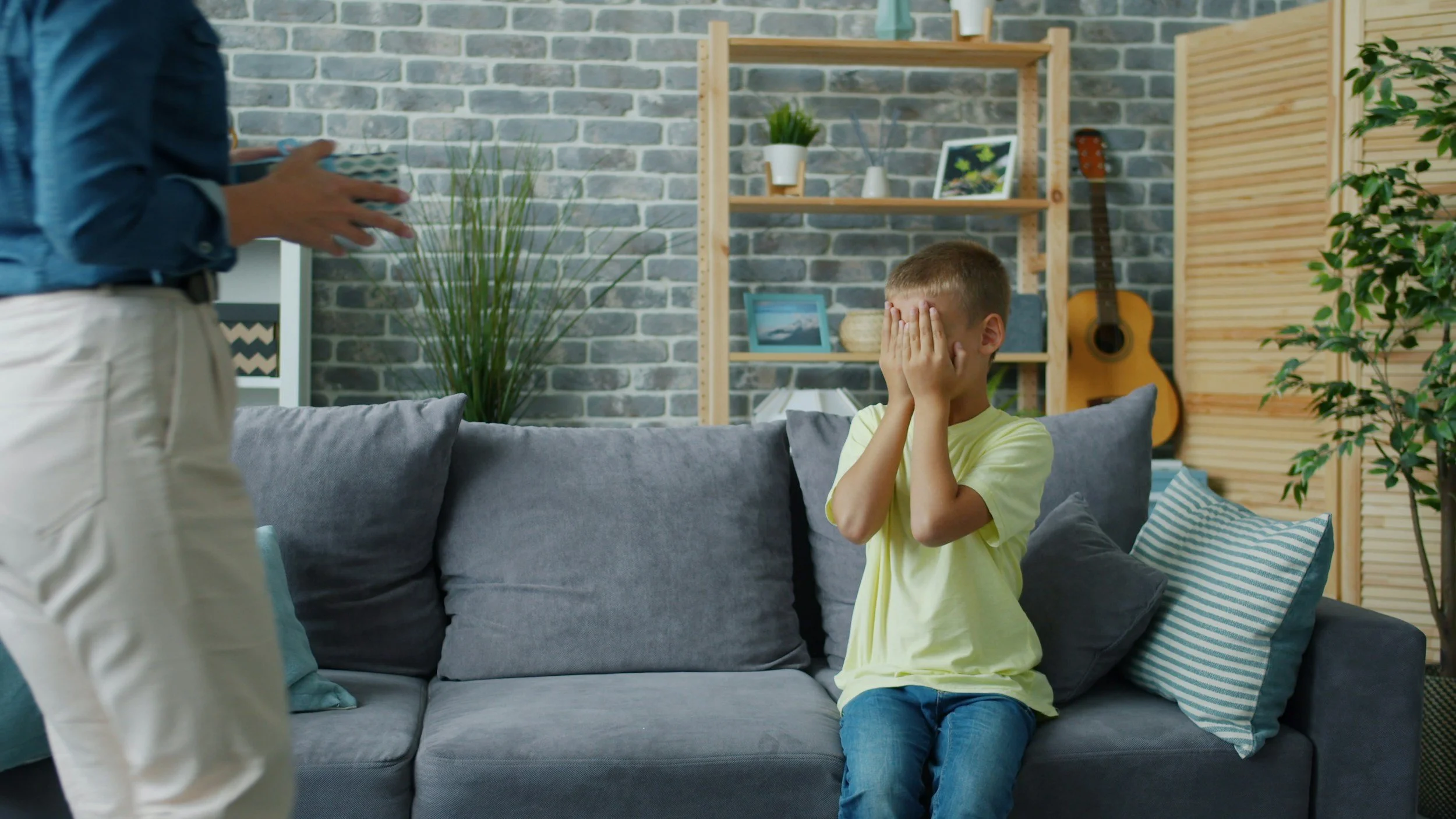
Children with ADHD are emotionally over-reactive, as one of the braking (inhibition) areas in the brain is involved in emotional control and regulation. Almost all of these kids react intensely, particularly to frustration and anger, and because of their impulsivity, they will often say what all other children think. This results in them getting themselves in a lot of trouble, and parents often have to deal with their own frustration towards these kids and intervene with teachers, neighbors, etc., because of their reactivity. A helpful way to think of their emotions is this: every molehill gets reacted to as if it is a mountain.
Remember
Accept the fact that children with ADHD require more energy to raise than other children. Parents of younger ADHD children need to constantly keep them safe and focused during their elementary years, while fighting the homework battles, and often in the middle and high school years, dealing with their problem behaviors at home and at school. ADHD Life is difficult, and when we accept this fact, its challenges become less daunting. The stress may still be there, but it is manageable.
While understanding these facts and their consequences in daily life with these children will not make raising them easy, it will make it less demanding and exhausting. Finding people in the community who understand young people with ADHD can make raising these children less difficult and even joyful.
Navigating the Journey of Raising a Child with ADHD
Dr. Russel Barkley is a leading authority on ADHD. His principles for raising a child with ADHD are accepted as foundational advice for parents. These practices are based on decades of study and research into the nature of ADHD and the very best practices for helping children establish better control. Post these practices around so you can remember: they are your roadmap to fostering your child’s strengths, building their self-esteem, and cultivating a nurturing and understanding home environment.
12 Principles of Raising a Child with ADHD
Based on the work of Russell Barkley
Principle 1. Use the Keys to Success
Seek a professional evaluation to understand your child’s needs.
Identify and nurture your child’s special talents and aptitudes.
Find community resources that can help develop these strengths.
Believe in, accept, and offer your child ongoing support.
Principle 2. Remember That It’s a Disorder!
Understand that children with ADHD often experience a 30% delay in focusing and self-control, especially in situations they find uninteresting or boring.
Adjust your expectations, discipline, and interventions to match your child’s self-control or executive age. Remembering the 30% rule can significantly reduce conflict between you and your child or teen.
Principle 3. Be a Shepherd, Not an Engineer
Provide protection and a safe environment for your child.
Choose the best neighborhood possible to support your child’s growth.
Recognize that parental influence is strongest when children are younger.
Make accommodations for delays in attention span, organizational skills, and self-control.
Create a home that is fun, interesting, stimulating, and educational, with activities like a swing set, educational toys, and engaging books.
Provide good nourishment by reducing junk food and sugary drinks, and offering more nutritious meals.
Establish consistent and predictable routines for mornings, dinnertime, homework, bedtime, and more.
Take good care of yourself as a parent—this is critical for your child’s well-being.
Focus on nutrition, regular exercise, and ensuring adequate sleep for both you and your child.
Remember to recharge your emotional batteries.
Principle 4. Get Your Priorities Straight
Avoid arguments over minor issues.
Determine which requests or rules you can let go.
Identify times of day that are especially challenging and prioritize the most important tasks during those periods.
Consider whether a request or task will help your child’s development and functioning.
Focus on what is important and urgent, and let go of unimportant matters.
Manage transitions smoothly and effectively.
Principle 5. Mindful Parenting: Be There and Be Aware
Practice mindful parenting by staying present and aware of your child’s needs, behaviors, and emotions.
Principle 6. Promote Your Child’s Self-Awareness and Accountability
Model self-awareness and accountability by evaluating your own actions out loud and discussing others’ feelings and reactions.
Narrate social situations to your child, describing interactions among other children.
Interview your child about their life, friends, behaviors, and emotions.
Use both verbal and nonverbal cues to guide your child when their behavior is inappropriate.
Incorporate random timing and consequences, such as timers that go off at unpredictable intervals.
Utilize picture cues to address problem behaviors and to recognize and reinforce positive actions.
g. Turtle technique- stop and scan the room.
h. Mirror Method- do work facing a mirror.
i. Cues for older kids
a. Paper clip, etc.
b. Tap on the shoulder*
c. Secret verbal signal*
d. Random tones
e. Vibrating cueing system.
j. Use videos of the child’s behavior and social interactions.
k. Day in review sessions.
l. Teach children Mindfulness Meditation
m. Consider a Behavior Report Card.
n. Social Commitments.
o. Clarify household rules and reinforce them consistently.
PRINCIPLE 7. Touch More, Reward More, Talk Less
Problem: Parents of children with ADHD talk too much, and the self-motivation of children with ADHD and ADD is weak.
Solution: Touch more, talk less, and use frequent, immediate, and external rewards at the point of performance.
a. When asking your child to do something for you, put your hand on the child’s shoulder or arm, look into their eyes, briefly say what needs to be said, have the child repeat the instruction, and depart with a show of affection.
b. Because usual rewards and motivation with schoolwork and chores are too weak for children with ADHD, use immediate and frequent feedback and consequences to sustain behavior towards a task, such as a home token program or point system.
c. Think of self-motivation and organization skills, etc., as a fuel tank that needs to be replenished for everyone. This can be done by using frequent rewards, self-talk, cutting down the work into smaller units by taking frequent breaks, taking a pause for three minutes to relax or to focus on your breathing, clearing the mind of negative thoughts, visualizing reaching the goal and enjoying the reward, using a picture of the reward, and exercising often.
d. Cautions: don’t reward everything, especially those things that the child finds interesting or pleasurable, as this will decrease their interest and pleasure in these activities.
PRINCIPLE 8. Make Time Real
Problem: Time “escapes” children with ADHD.
Solution: Externalize time and break it down.
a. Remember, whenever you put a time limit or requirement on anything for your child with ADHD, you are disabling the child (exception – immediate deadlines can be motivating).
b. Use external clocks for short texts. Timers are especially helpful. Reduce or eliminate time delays on assignments for long-term projects by breaking them up into sub-projects, each with a deadline and important consequences.
c. Use 3 x 5 cards for multi-step projects.
d. Create a daily timeline for school days.
e. Use a calendar to show your child how many days there are before special activities or events.
f. Manage waiting time by distracting your child with activities such as games on cell phones or tablets, taking along small toys that are enjoyable, and for unexpected times, getting creative and acting fast, such as finding something, singing a song, playing a road trip game, etc.
PRINCIPLE 9. Working Memory Isn’t Working: Offload It and Make It Physical!
Problem: Children with ADHD can’t hold in mind the information they need to complete tasks.
Solution: Offload working memory and make it physical.
a. Transfer necessary information to something that can be seen, including making lists, making picture sequences, providing written rules for homework and chores, making chore cards, encouraging self-talk out loud, creating behavior contracts, and using smart devices.
PRINCIPLE 10. Get Organized
Problem: ADHD disrupts self-organization
Solution: Help your child get and stay organized at the point of performance
a. Find the best place for children to perform - few distractions, and that can frequently be monitored by a parent or teacher.
b. Identify the materials that need to be located at this place in order to complete the tasks.
c. Identify the best time for this kind of work to be done.
d. Organize play spaces.
e. Don’t let the organization override its purpose.
PRINCIPLE 11. Make Problem-Solving Concrete
Problem: People with ADHD have trouble holding things in mind and manipulating them to solve problems.
Solution: Make problem-solving physical and manual.
a. Externalize mathematics calculation by using a number line, poker chips, marbles, Legos, and a calculator, and use number tables to perform calculations.
b. Writing assignments about a reading passage. Scan, glance over the passage, read the first paragraph and vocalize what it says, and write down ideas about it or make a picture about it. Then, review each part after it has been done after each paragraph.
c. Four steps to every problem:
1. State the problem out loud.
2. Break it down into specific, smaller steps.
3. Brainstorm solutions and write a giant idea down, and don’t evaluate.
4. Critique and sort the ideas you have written down. Have the child state the advantages and disadvantages of each solution. When the solution is decided, have the child assist in organizing the steps and a plan.
5. State the situation and break it down, list the options, note the advantages and disadvantages, note the problems with each, and then see if a solution is evitable*.
PRINCIPLE 12. Be Proactive: Plan for Difficult Situations at Home and Away
Problem: Parents of children with ADHD often operate in the reactive mode
SOLUTION: Get Proactive
a. Make a list of problem situations in the home or in public places.
b. Think about what you could do beforehand or in the situation to head off the problem behavior.
c. Keep in mind your child’s thirty percent delay in their ability to focus attention and self-control difficulties, particularly in boring situations.
d. Develop transitions in those situations that are problematic by stating the rules, the reward that can be earned, and the negative consequences, and have something for your child to do.
e. Put the transition plan into action before entering a problem situation. Explain to your child the plan. Review the rules, explain the reward, explain the punishment, give the child something to do right away, and give frequent feedback, particularly positive feedback, throughout the situation, and evaluate at the end.
13: Additional Problem.
Problem: Children with ADHD are emotionally overreactive and often dysregulated.
Solution: Understand the six places to head off emotional dysregulation.
a. Choose your situations carefully, avoiding, when possible, those that are problematic.
b. Modify the situation.
c. Focus and redirect attention.
d. Change the child’s thinking about it.
e. Modify the child’s response.
f. Alter the consequences.
14. Practice Forgiveness daily.
a. Forgiving your child by reminding yourself of their problems with attention, particularly in boring situations. Watch your child sleeping. Make a list of your frustrations with the child. Practice forgiveness.
b. Forgiving yourself for not being a perfect parent and/or becoming exasperated.
c. Forgiving others who don’t understand the challenges that a person with ADHD or a parent of an ADHD child has and make judgments or nasty remarks about the child and about your parenting skills.




Parenting Strategies for ADHD: A Guide to Success
Parenting a child with ADHD requires a shift in perspective—moving from a mindset of "fixing behavior" to one of scaffolding success. Because ADHD is essentially a delay in the brain’s executive functions, children often know what to do, but their brains struggle to execute it in the moment.
1. Build a Foundation of Structure
Predictability reduces the cognitive load on a child with ADHD. When the environment is organized, the brain doesn't have to work as hard to figure out what comes next.
Routine is King: Use visual schedules for morning and bedtime routines. Post them in high-traffic areas like the kitchen or bathroom.
Externalize Time: Children with ADHD often experience "time blindness." Use analog clocks, sand timers, or apps like Time Timer to make the passage of time visible.
The "Launch Pad": Designate a specific spot by the door for backpacks, shoes, and sports gear to eliminate the frantic morning search.
2. The Power of Positive Redirection
The "ADHD tax" often includes a high volume of daily corrections. To combat the toll this takes on self-esteem, aim for a 5:1 ratio of positive comments to redirections.
Immediate Feedback: Praise or rewards should happen as close to the desired behavior as possible.
Catch Them Being Good: Explicitly notice when they follow a transition smoothly or stay focused for five minutes. "I noticed how quickly you put your shoes on—that really helped us get out the door!"
Give "When/Then" Choices: Instead of "Clean your room or no TV," try "When your Lego blocks are in the bin, then we can turn on the show."
3. Communication Strategies
Long-winded explanations often get lost in the "noise" of an ADHD brain. Keep it brief and interactive.
The 10-Word Rule: Try to give instructions in 10 words or fewer.
Eye Level Engagement: Get on their physical level and ensure eye contact before giving a command.
The "Repeat Back" Method: Ask your child to briefly repeat what you just asked them to do to ensure the information was actually encoded.
4. Collaborative Problem Solving
When "willpower" isn't the issue, "skill power" usually is. If a child repeatedly fails at a task, look for the lagging skill rather than assuming defiance.
Analyze the Friction: If they won't clean their room, is it because the task is too large? Try breaking it into "micro-tasks" (e.g., "Just pick up the red things first").
Natural Consequences: Whenever safe, let natural consequences do the teaching. Forgetting a lunchbox leads to hunger, which is a more effective teacher than a 20-minute lecture.
A Note on Self-Care: You cannot pour from an empty cup. ADHD parenting is intensive. Radical patience for your child begins with radical compassion for yourself.
📅 Daily Routine: The "Flow" System
This schedule uses color-coding and clear blocks to help a child see exactly where they are in their day.
🌅 Morning: The Launchpad
Focus: High structure, minimal distractions.
7:00 AM: ☀️ Wake Up & Lights On (Open those curtains!)
7:15 AM: 🦷 Self-Care Circuit (Potty, brush teeth, wash face).
7:30 AM: 🍳 Protein-Rich Breakfast (Great for brain fuel).
7:50 AM: 👕 Get Dressed (Layout clothes the night before to save "brain points").
8:10 AM: 🎒 Bag Check (Shoes on, backpack by the door).
☀️ Afternoon: The Transition Zone
Focus: Decompression and movement.
3:30 PM: 🏠 Home & Snack (Hydrate and eat before the "medication crash" hits).
4:00 PM: 🏃 Big Movement Break (Trampoline, bike ride, or tag. Burn off the stored energy).
4:30 PM: 📚 Body Doubling Homework (Sit with them while they work, even if you’re just reading a book nearby).
5:30 PM: 🧸 Free Choice (Screen time or play—clear "timer" needed for the end).
🌙 Evening: The Wind-Down
Focus: Lowering stimulation.
6:30 PM: 🍽️ Dinner & Connection (No screens, just talk).
7:15 PM: 🛁 Warm Bath/Shower (Helps lower core body temperature for sleep).
7:45 PM: 📖 Quiet Activity (Reading, LEGOs, or drawing in bed).
8:15 PM: 😴 Lights Out (White noise or brown noise can be a lifesaver).
🛠️ 3 Pro-Tips for Success
Use a "Now/Next" Board: For a child who gets overwhelmed, hide the whole schedule and only show two things: Now (Putting on shoes) and Next (Getting in the car).
The "5-Minute Warning": Transitions are the hardest part of ADHD. Use a visual timer (like a Time Timer) so they can see the red disappearing.
Gamify the Boring Stuff: Use a sticker chart or a "beat the clock" challenge for tasks like brushing teeth or picking up toys.
Quick Note: Be gentle with yourself and your child. Some days the schedule will fall apart, and that’s okay. The goal is a rhythm, not perfection.
Structuring a day for a child with ADHD isn't about rigid control—it’s about creating "external brain" support. Since ADHD can impact executive functions like time perception and sequencing, a visual schedule acts as a reliable anchor that reduces anxiety and "power struggles."
Here is a sample schedule designed to balance high-energy bursts with necessary downtime.
📅 Sample Daily Schedule
Time BlockActivityWhy it helps7:00 AMRise & ShineUse a "vibrating" or light-up alarm to avoid jarring noises.7:15 AMThe Big 3Dress, Eat, Brush Teeth. Use a checklist here!8:00 AMMovement Break10 mins of jumping jacks or "heavy work" to wake up the brain.8:30 AMSchool/LearningBreak tasks into 20-minute chunks.12:00 PMRefuel & ResetHigh-protein lunch; limited screen time to prevent "transition tantrums."3:30 PMDopamine HitOutdoor play, sports, or creative "free play."5:00 PMHomework/ChoresUse a visual timer (like a Time Timer) to show time passing.6:30 PMWinding DownDim lights, warm bath, no electronics.8:00 PMSleep ReadyReading or audiobooks to quiet the mind.
Export to Sheets
💡 Key Design Principles
When creating your physical version, keep these three things in mind:
Use Visual Cues: Use icons or photos of the child doing the task. This makes the expectation concrete rather than abstract.
The "Now & Next" Method: If a full day is overwhelming, use a board that only shows two cards: what they are doing Now and what comes Next. This reduces "cognitive load."
Color Coding: Use green for "go" activities (play/fun), yellow for "transition" (cleanup), and blue for "calm" (reading/sleep).
🛠️ Pro-Tip: The "Brain Break"
For kids with ADHD, the transition between tasks is often where things fall apart. Incorporate a 5-minute "buffer" between blocks where they can stretch or listen to one song. This allows the brain to shift gears effectively.
Would you like me to help you draft a specific "Morning Routine Checklist" that your child can check off as they go?

Pin your important notes to the top.
Morning Routine for Kids
Wake up & open curtains
Bathroom (potty, wash face, brush teeth)
Get dressed (clothes laid out)
Eat high-protein breakfast
Put on shoes & grab backpack
Final mirror check (smile & go!)